Global Architecture
This document provides a high-level overview of the R-Type project architecture, explaining how the different layers and components interact with each other.
Architecture Diagram
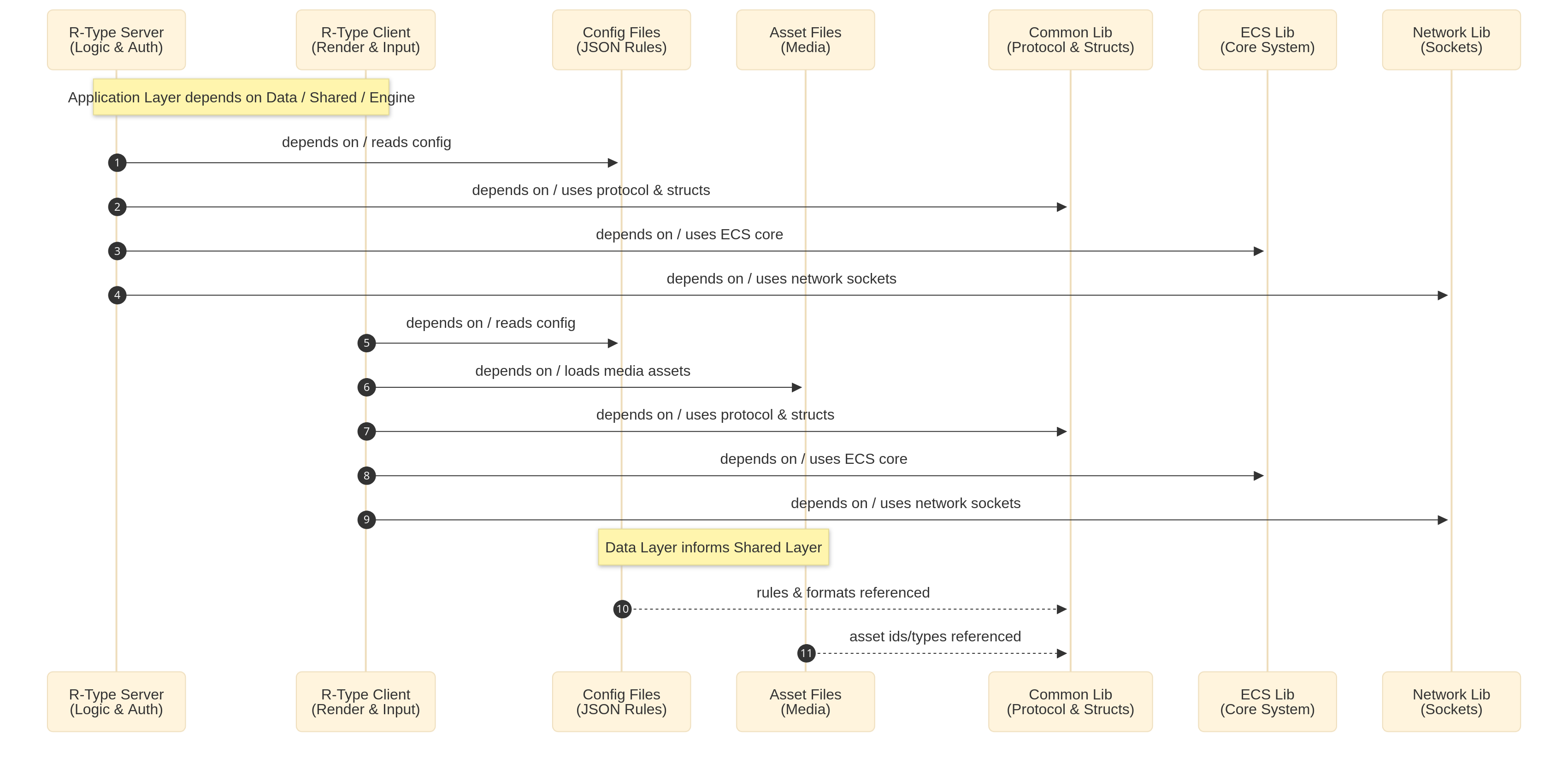
Layered Architecture Overview
The R-Type project follows a layered architecture pattern with clear separation of concerns. The system is divided into three main layers:
- Application Layer - Game-specific executables (Server & Client)
- Engine Layer - Reusable game engine libraries (ECS, Network)
- Data Layer - Configuration and assets
Components
Application Layer
R-Type Server (Logic & Auth)
The server is the authoritative source of truth for the game state. It handles:
- Game logic execution
- Player authentication and session management
- Entity spawning, updating, and destruction
- Broadcasting state updates to all connected clients
- Anti-cheat validation
Dependencies:
- Config Files → Reads server configuration (ports, tick rate, etc.)
- Common Lib → Uses shared protocol definitions and data structures
- ECS Lib → Manages game entities using the Entity Component System
- Network Lib → Handles UDP socket communication
R-Type Client (Render & Input)
The client provides the player-facing interface. It handles:
- Rendering the game world
- Capturing and sending player input
- Local prediction for responsive gameplay
- State interpolation for smooth visuals
- Audio playback
Dependencies:
- Config Files → Reads client configuration (controls, video settings)
- Asset Files → Loads textures, sounds, fonts
- Common Lib → Uses shared protocol definitions and data structures
- ECS Lib → Local entity management for rendering
- Network Lib → Communicates with server via UDP
Engine Layer
ECS Lib (Core System)
The Entity Component System library provides the core game engine functionality:
- Entity creation and destruction
- Component storage and retrieval (using sparse sets)
- System registration and execution
- Entity queries and iteration
This library is game-agnostic and can be reused for other projects.
Network Lib (Sockets)
The network library provides low-level networking primitives:
- UDP socket abstraction
- Cross-platform socket implementation
- Send/receive operations
- Connection management
This library handles raw bytes and is protocol-agnostic.
Common Lib (Protocol & Structs)
The common library contains shared definitions used by both client and server:
- RTGP protocol packet definitions
- Serialization/deserialization utilities
- Shared data structures (components, enums)
- Constants and configuration types
This ensures consistency between client and server implementations.
Data Layer
Config Files (JSON/TOML Rules)
Configuration files define runtime behavior without recompilation:
config/
├── client/
│   ├── controls.json    # Key bindings, gamepad mappings
│   └── video.toml       # Resolution, fullscreen, vsync
└── server/
    ├── server.toml      # Port, tick rate, max players
    └── gameplay.toml    # Difficulty, wave settings
Asset Files (Media)
Asset files contain game resources:
assets/
├── img/         # Sprites, backgrounds
├── audio/       # Music, sound effects
├── fonts/       # UI fonts
└── shaders/     # GLSL fragment shaders
Library Structure
The engine libraries are located in the lib/ directory:
lib/
├── ecs/         # Entity Component System core
├── common/      # Shared utilities (Logger, ArgParser, Serializer)
├── network/     # Network socket abstraction
├── display/     # Graphics rendering with SFML
├── audio/       # Sound system with SDL2
├── background/  # Parallax scrolling backgrounds
└── engine/      # Game engine abstraction layer
Dependency Flow
The architecture enforces a unidirectional dependency flow:
┌─────────────────────────────────────────────────────────────┐
│                    APPLICATION LAYER                        │
│  ┌─────────────────┐              ┌─────────────────┐       │
│  │     Server      │              │     Client      │       │
│  └────────┬────────┘              └────────┬────────┘       │
│           │                                │                │
└───────────┼────────────────────────────────┼────────────────┘
            │         depends on             │
            ▼                                ▼
┌─────────────────────────────────────────────────────────────┐
│                      ENGINE LAYER                           │
│  ┌──────────┐    ┌──────────────┐    ┌──────────────┐       │
│  │   ECS    │    │    Common    │    │   Network    │       │
│  │   Lib    │    │     Lib      │    │     Lib      │       │
│  └──────────┘    └──────────────┘    └──────────────┘       │
│                                                             │
└─────────────────────────────────────────────────────────────┘
            ▲                                ▲
            │          references            │
            │                                │
┌───────────┼────────────────────────────────┼────────────────┐
│           │        DATA LAYER              │                │
│  ┌────────┴────────┐              ┌────────┴────────┐       │
│  │  Config Files   │              │   Asset Files   │       │
│  └─────────────────┘              └─────────────────┘       │
│                                                             │
└─────────────────────────────────────────────────────────────┘
Key Principles
| Principle | Description |
|---|---|
| Downward Dependencies | Higher layers depend on lower layers, never the reverse |
| No Circular Dependencies | Each component has clear, one-way dependencies |
| Interface Segregation | Libraries expose minimal, focused interfaces |
| Data Separation | Configuration and assets are external to code |
Build Targets
The architecture maps to CMake build targets:
| Target | Type | Description |
|---|---|---|
r-type_server | Executable | Server application |
r-type_client | Executable | Client application |
rtype_ecs | Static Library | ECS engine core (lib/ecs/) |
rtype_network | Static Library | Network socket layer (lib/network/) |
rtype_common | Static Library | Shared utilities & protocol (lib/common/) |
rtype_display | Static Library | Graphics rendering (lib/display/) |
rtype_audio | Static Library | Sound system (lib/audio/) |
rtype_background | Static Library | Parallax backgrounds (lib/background/) |
rtype_engine | Static Library | Game engine abstraction (lib/engine/) |
Communication Flow
┌────────────┐                                ┌────────────┐
│   Client   │                                │   Server   │
│            │         C_CONNECT              │            │
│            │ ─────────────────────────────► │            │
│            │         S_ACCEPT               │            │
│            │ ◄───────────────────────────── │            │
│            │                                │            │
│            │         C_INPUT                │            │
│            │ ─────────────────────────────► │            │
│            │                                │  Process   │
│            │      S_ENTITY_SPAWN            │  Inputs    │
│            │ ◄───────────────────────────── │            │
│            │      S_ENTITY_MOVE             │  Update    │
│            │ ◄───────────────────────────── │  State     │
│            │      S_ENTITY_DESTROY          │            │
│            │ ◄───────────────────────────── │            │
│  Render    │                                │            │
│  World     │                                │            │
└────────────┘                                └────────────┘
Benefits of This Architecture
Maintainability
- Clear boundaries between components
- Changes in one layer don't ripple to others
- Easy to locate code for specific functionality
Testability
- Libraries can be tested in isolation
- Mock implementations can replace real dependencies
- Unit tests don't require full application context
Reusability
- ECS and Network libraries are game-agnostic
- Engine can be used for other game projects
- Common definitions shared between client/server
Scalability
- New features added without modifying core libraries
- Multiple games can share the same engine
- Easy to add new platforms or clients
Related Documentation
- File Architecture - Detailed file and directory structure
- Network Architecture - Network protocol and communication
- ECS Guide - Entity Component System details